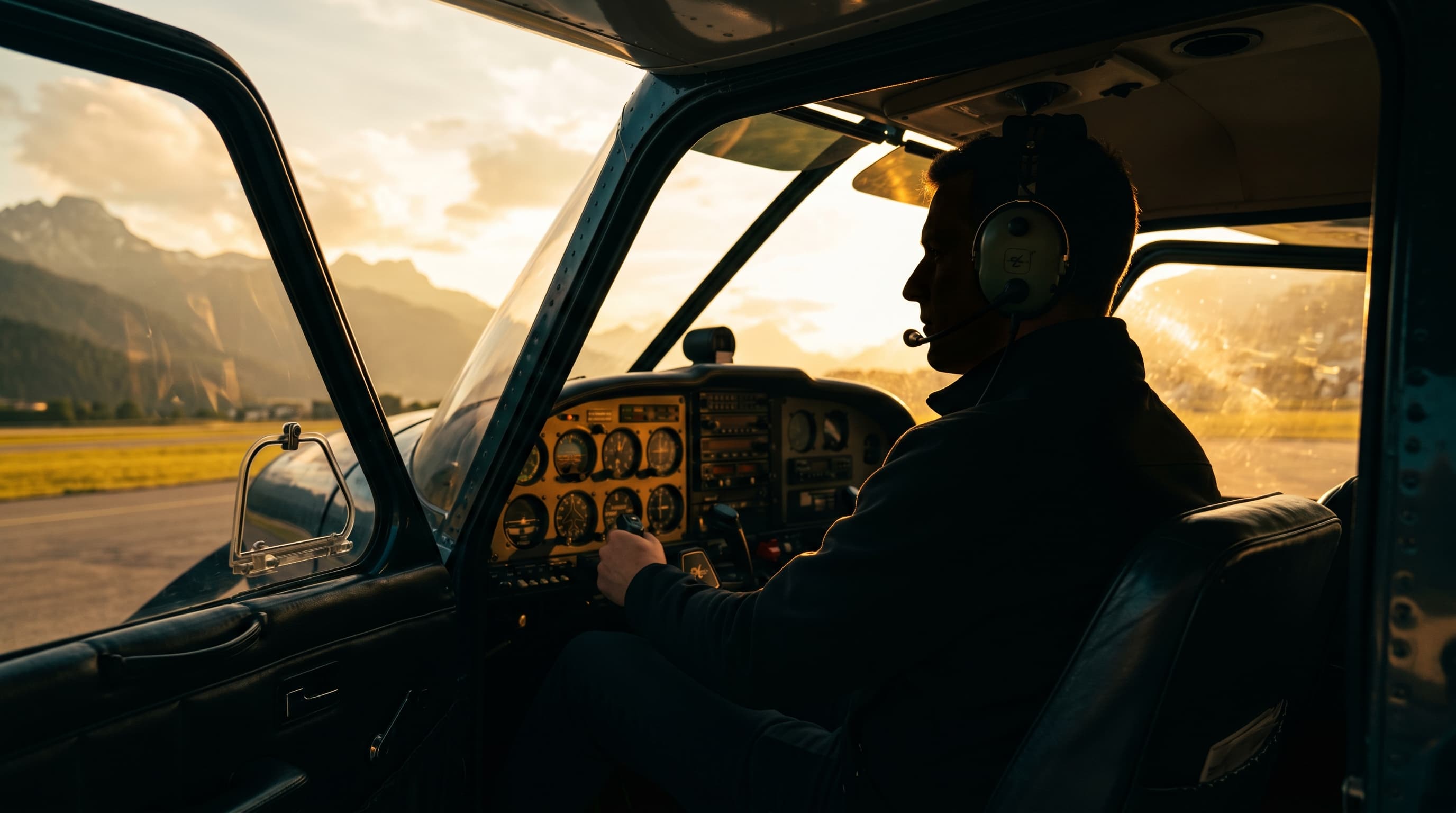
The LAPL(A), or Light Aircraft Pilot Licence for aeroplanes, is the EASA licence to fly as pilot-in-command of single-engine piston aeroplanes and touring motor gliders up to 2,000 kg maximum take-off mass, valid in all EASA member states. It takes at least 30 hours of flight training, including 15 hours dual and 6 hours supervised solo, plus theory exams in 9 subjects and at least an LAPL medical. Once you have flown 10 hours as pilot-in-command after the licence is issued, you may carry up to three passengers (FCL.105.A).
What does LAPL(A) stand for?
LAPL(A) stands for Light Aircraft Pilot Licence. The LAPL(A) is the aeroplane variant, governed by EASA regulations (Part-FCL) and valid across all EASA member states. It was introduced as part of a broader effort to make general aviation more accessible across Europe without compromising flight safety.
Unlike the PPL(A), which traces its origins to ICAO standards, the LAPL(A) is a European-only licence. That distinction matters when planning where you intend to fly, but for the pilot whose ambition is to explore Switzerland, France, Italy, and Germany from the air, the LAPL(A) covers everything you need.
What can you do with a LAPL(A)?
The LAPL(A) entitles you to act as pilot-in-command of single-engine piston aircraft with a maximum take-off weight of 2,000 kg (FCL.105.A). After 10 hours as pilot-in-command following licence issue you may carry up to three passengers, which means a full cockpit for weekend adventures. The licence is valid within EASA airspace.
- -Fly single-engine piston aircraft (SEP) up to 2,000 kg MTOW
- -Carry up to three passengers, after 10 hours as pilot-in-command following licence issue (FCL.105.A)
- -Operate in all EASA member states, including Switzerland, Austria, Germany, France and Italy
- -Share costs with passengers on a non-commercial basis
Night flying is not included in the basic LAPL(A), but a Night Rating can be added later. The LAPL(A) is an EASA licence, valid in the EASA member states, and the PPL(A) is issued to ICAO Annex 1 standards.
Training requirements
The LAPL(A) training programme requires 30 hours of flight time, against 45 for the PPL(A). EASA sets minimum hours, but a flight school's training standard reflects the number of hours a typical student needs to reach a safe and competent standard.
- -30 hours total flight time (FCL.110.A), a regulatory minimum
- -15 hours dual instruction with a certified flight instructor
- -6 hours solo flight time, including a supervised solo cross-country of at least 80 nm
- -Ground school covering the 9 EASA theory subjects
- -LAPL(A) medical or EASA Class 2 medical certificate from an Aero-Medical Examiner
The practical skill test is conducted with an EASA-authorised examiner. It covers all core flying skills: basic handling, navigation, circuit flying, emergency procedures, and radio communication. The medical requirements for the LAPL(A) are slightly less demanding than for the PPL(A), which can be relevant for applicants with minor health considerations.
LAPL(A) vs PPL(A): the short version
The two licences serve different pilots. Here is where they differ at a glance:
- -Hours: LAPL(A) requires 30h minimum (PPL(A) requires 45h minimum)
- -Aircraft weight: LAPL(A) is limited to 2,000 kg MTOW (PPL(A) has no weight restriction for SEP)
- -Geography: LAPL(A) is valid in EASA states only (PPL(A) is an ICAO-standard licence)
- -Career path: LAPL(A) leads to a CPL(A) or IR(A) via the PPL(A) upgrade or an integrated CPL(A) or CPL(A)/IR course (the PPL(A) opens the IR and the modular professional route)
If these distinctions matter to your plans, the full comparison is covered in detail in our article on PPL(A) vs LAPL(A). The short answer: if you want international freedom or a professional path, start with a PPL(A). If you want to fly recreationally across Europe at the lowest entry point, the LAPL(A) is designed exactly for you.
Medical requirements
The LAPL(A) medical is conducted by an Aero-Medical Examiner (AME) or an Aero-Medical Centre and is specifically designed for recreational pilots. It is less intensive than the EASA Class 2 medical required for the PPL(A), making it accessible to a wider range of applicants. If you already hold a valid Class 2 medical, it covers the LAPL(A) requirements. Many students find the medical straightforward. Your instructor or our training team can direct you to a qualified AME in Switzerland.
The LAPL(A) requires 30 hours of flight time against 45 for the PPL(A), and it is valid in EASA member states.
Is the LAPL(A) right for you?
The LAPL(A) is the right licence for a specific kind of pilot. You are likely a strong candidate if:
- -Your goal is recreational flying: weekends over the Alps, cross-country trips through Europe, flying for the pure experience of it
- -You want to start flying with a smaller upfront commitment and reach your licence faster
- -You have no current plans to pursue a commercial licence or fly outside EASA airspace
- -You want the option to upgrade later: a LAPL(A) can be converted to a PPL(A) with additional training
The LAPL(A) is also a first step for pilots who are unsure whether aviation is for them. The commitment to a PPL(A) is significant; the LAPL(A) lets you earn a real licence, build real hours, and decide at a later point whether you want to go further. At alpaviation, we train LAPL(A) students with the same standard of instruction we apply to PPL(A) training.
The LAPL(A) is a full pilot licence, with real responsibilities and real privileges. It requires 30 hours of flight time against 45 for the PPL(A) and is valid in EASA member states, which is enough for the pilot whose ambitions sit within Europe and within the world of recreational aviation. If that is you, the first step is a conversation, and we are always ready for that.
Frequently asked questions
How many flight hours does a LAPL(A) require?
The LAPL(A) requires 30 hours of total flight time as a regulatory minimum. Within the minimum, 15 hours are dual instruction and 6 hours are solo, including a supervised solo cross-country of at least 80 nm.
What aircraft can you fly with a LAPL(A)?
The LAPL(A) entitles you to act as pilot-in-command of single-engine piston aircraft with a maximum take-off weight of 2,000 kg. You may carry up to three passengers once you have flown 10 hours as pilot-in-command after licence issue.
Where is a LAPL(A) valid?
The LAPL(A) is an EASA licence, valid in all EASA member states, which include Switzerland, Austria, Germany, France and Italy. The PPL(A) is issued to ICAO Annex 1 standards.
Can you fly at night with a LAPL(A)?
Night flying is not included in the basic LAPL(A). A Night Rating can be added later.
Can a LAPL(A) be converted to a PPL(A)?
Yes. A LAPL(A) can be converted to a PPL(A) with additional training. The PPL(A) opens international flying, the Instrument Rating and the modular professional route, and the upgrade credits your LAPL(A) training. The integrated CPL(A) and CPL(A)/IR courses also admit ab-initio entrants.
Related reading
Start your LAPL(A) journey
Speak with our training team to understand exactly what your LAPL(A) path looks like: timeline, costs, and what to expect at each stage.
Get in Touch