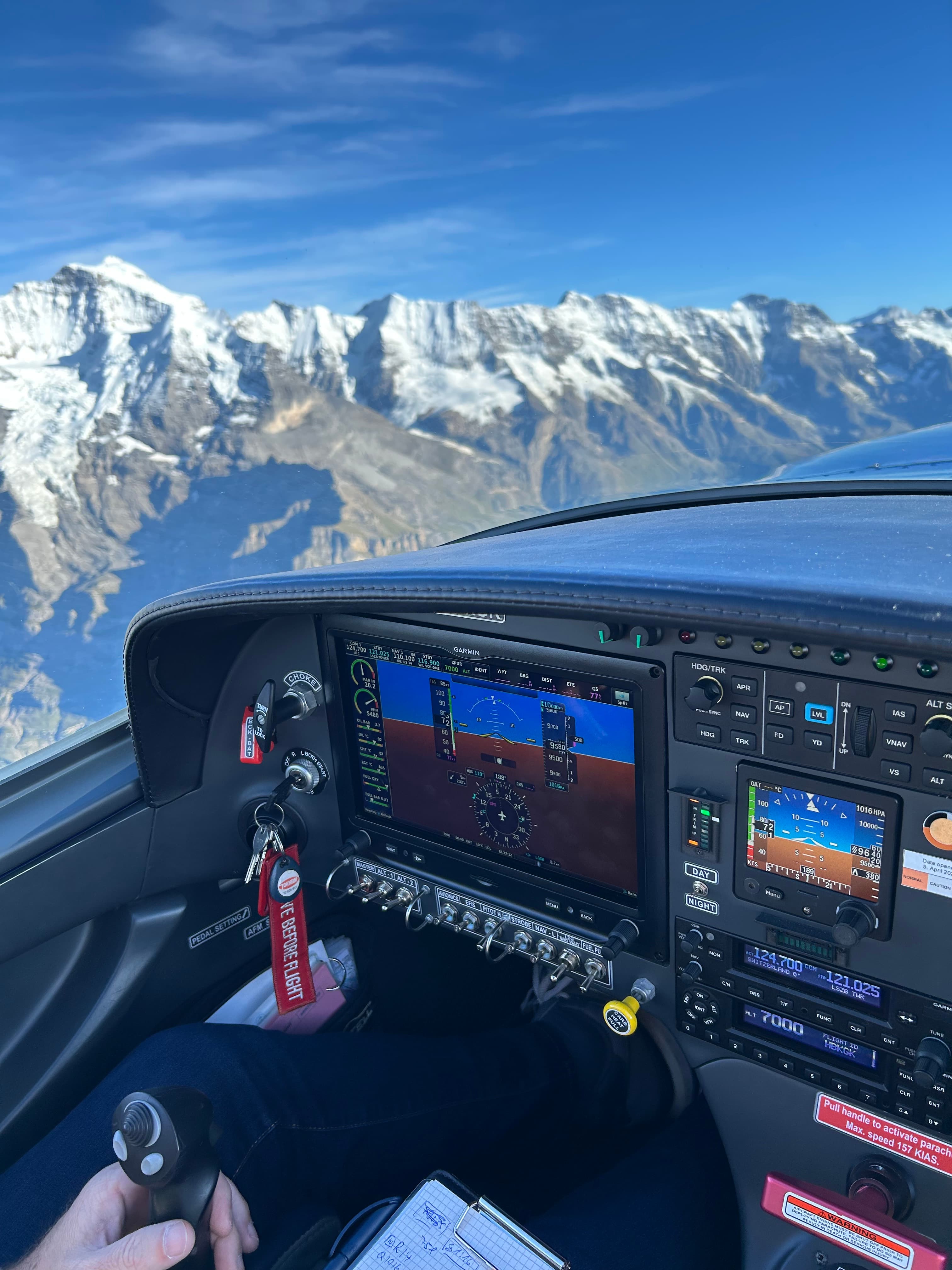
The LAPL(A) requires 30 hours of flight time and is valid in EASA member states. The PPL(A) requires 45 hours and is the foundation of the modular route to the Instrument Rating and the professional licences. Both licences will put you in the pilot seat. Both are fully EASA-compliant. But they serve different pilots, open different doors, and carry different costs.
The core difference in one sentence
The LAPL(A) is designed for recreational pilots who want to fly within EASA airspace with the minimum training investment. The PPL(A) is the international standard and the foundation of the modular route to the Instrument Rating and the professional licences.
That distinction shapes everything else: the hours required, the costs involved, the medical you need, the aircraft you can fly, and where in the world you can fly them.
Training comparison
The training programmes differ in scale. Both are conducted under EASA Part-FCL and both require a practical skill test with an authorised examiner.
- -Minimum flight hours. LAPL(A): 30 hours | PPL(A): 45 hours (FCL.110.A / FCL.210.A)
- -Dual instruction. LAPL(A): 15 hours minimum | PPL(A): 25 hours minimum
- -Solo flight time. LAPL(A): 6 hours minimum | PPL(A): 10 hours minimum
- -Cross-country solo. LAPL(A): 80 nm qualifying flight | PPL(A): 150 nm qualifying flight with two intermediate stops
- -Theory subjects. Both require ground school across 9 EASA theory subjects
In practice, actual hours flown will exceed the regulatory minimums for most students. The gap between the two programmes in real terms is typically 10-20 additional flight hours for the PPL(A), which is also 10-20 hours of additional experience and confidence before you fly with passengers.
Privileges comparison
This is where the two licences diverge most significantly. What can you actually do with each one?
- -Aircraft weight. LAPL(A): limited to 2,000 kg MTOW single-engine piston | PPL(A): no weight restriction for SEP aircraft
- -Passengers. LAPL(A) is capped at 3 passengers and 4 persons on board, and asks for 10 hours as pilot-in-command after licence issue before carrying any (FCL.105.A); PPL(A) is limited only by the aircraft's certificated seating
- -Geography. LAPL(A): valid in EASA member states only
- -Night flying. Neither licence includes night privileges by default; a Night Rating can be added to both
- -Advanced ratings. PPL(A): gateway to IR(A), MEP, CPL(A), ATPL(A) | LAPL(A): leads to a CPL(A) or IR(A) via the PPL(A) upgrade, which credits LAPL(A) training, or via an integrated CPL(A) or CPL(A)/IR course
For a recreational pilot whose entire flying life will be within EASA Europe, the LAPL(A) privileges are entirely sufficient. For anyone with ambitions beyond that boundary (international trips, professional goals, or even the flexibility of knowing your options are open), the PPL(A) privileges justify the additional training.
Cost comparison
Cost is usually a deciding factor. Current course prices are on our training pages, and we will quote precisely against your training schedule.
- -LAPL(A): the lower entry cost, with fewer flight hours and slightly less ground school
- -PPL(A): higher, with more flight hours, the full theory programme and wider privileges
- -LAPL(A) to PPL(A) conversion: additional training on top, depending on the hours already logged
The LAPL(A) is the lower entry cost. But if you later decide to convert to a PPL(A), you will pay for the additional training separately, meaning the total cost can exceed a direct PPL(A) path. If there is any realistic chance you will want a PPL(A) eventually, training for one directly is usually more cost-effective.
Both licences put you in the pilot seat. The question is which one fits your ambitions.
Can you convert a LAPL(A) to a PPL(A)?
Yes. Under FCL.210.A(b), previous LAPL(A) training is credited towards the PPL(A), provided the LAPL(A) and PPL(A) training together meet the PPL(A) experience requirements. For an LAPL(A) holder with at least 45 hours of total flight time in aeroplanes or TMGs, the requirement is reduced to 40 hours of flight instruction, of which 21 hours dual. With an instructor qualified to instruct for the PPL(A), you complete at least 5 hours of dual flight instruction and the PPL(A) supervised solo flight time (FCL.210.A(a)(2)). The PPL(A) skill test follows.
The conversion is a straightforward process at alpaviation. Your existing LAPL(A) flight time counts fully toward the PPL(A) requirements. However, if you already know the PPL(A) is where you want to be, training for it directly from the start avoids the interruption and additional cost of a conversion programme.
Medical requirements
The LAPL(A) requires a LAPL(A) medical certificate, issued by an Aero-Medical Examiner (AME) or an Aero-Medical Centre. It is designed specifically for recreational pilots and is less demanding than the EASA Class 2 medical required for a PPL(A). The PPL(A) requires a valid EASA Class 2 medical, a more thorough examination, though one that the large majority of applicants in reasonable health pass without difficulty. If you already hold a Class 2 medical, it covers the LAPL(A) requirements as well. For most applicants, the medical difference between the two licences is minor; our training team can point you to a qualified AME in the Bern region.
Our recommendation
The right choice depends on what you want to do with the licence:
- -If you are undecided about how far you want to go in aviation, choose the PPL(A). It keeps every option open at a cost difference that is modest when spread over a training programme.
- -If you are certain your flying will be recreational and within EASA Europe, with no interest in commercial licences or international travel, the LAPL(A) is efficient, well-suited, and delivers everything you need.
- -If your goal is a professional licence, an Instrument Rating, or flying outside Europe, start with the PPL(A). From a LAPL(A), the Instrument Rating and the modular professional route go through the PPL(A) upgrade, which credits your LAPL(A) training; the integrated CPL(A) and CPL(A)/IR courses also admit ab-initio entrants.
Both programmes at alpaviation are taught to the same standard of instruction, by the same team of certified instructors. The difference between the two paths is in scope.
The decision between a PPL(A) and a LAPL(A) is worth getting right at the start. A clear conversation about your goals, your schedule, and your budget will almost always produce an obvious answer. At alpaviation, that conversation is always the first step, and it never costs anything. If you would like to talk through your options, we are here.
Frequently asked questions
Should you choose a PPL(A) or a LAPL(A)?
Choose the PPL(A) if you are undecided about how far you want to go in aviation, because it keeps every option open. The LAPL(A) suits a pilot who is certain their flying will be recreational and within EASA Europe. On the modular route, a professional licence and an Instrument Rating start with the PPL(A); so does flying outside Europe.
How many flight hours does each licence require?
The LAPL(A) minimum is 30 flight hours and the PPL(A) minimum is 45. Dual instruction is 15 hours against 25, and solo time is 6 hours against 10. Most students exceed the regulatory minimums, and the real gap is typically 10 to 20 additional flight hours for the PPL(A).
Can you fly outside Europe with a LAPL(A)?
No. The LAPL(A) is valid in EASA member states only. If international trips are part of your plans, that is one reason to train for the PPL(A) directly.
Which medical certificate does each licence require?
The LAPL(A) requires a LAPL(A) medical certificate, issued by an Aero-Medical Examiner or an Aero-Medical Centre, and the PPL(A) requires a valid EASA Class 2 medical. A Class 2 certificate covers the LAPL(A) requirements as well. For most applicants the difference between the two is minor.
Can you convert a LAPL(A) to a PPL(A)?
Yes. Under FCL.210.A(b), previous LAPL(A) training is credited towards the PPL(A), provided the LAPL(A) and PPL(A) training together meet the PPL(A) experience requirements. For an LAPL(A) holder with at least 45 hours of total flight time in aeroplanes or TMGs, the requirement is reduced to 40 hours of flight instruction, of which 21 hours dual. With an instructor qualified to instruct for the PPL(A), you complete at least 5 hours of dual flight instruction and the PPL(A) supervised solo flight time (FCL.210.A(a)(2)). The PPL(A) skill test follows.
Related reading
Discuss your training path
Speak with our team about your goals and we will give you a direct recommendation: PPL(A) or LAPL(A), and what the full path looks like from here.
Get in Touch