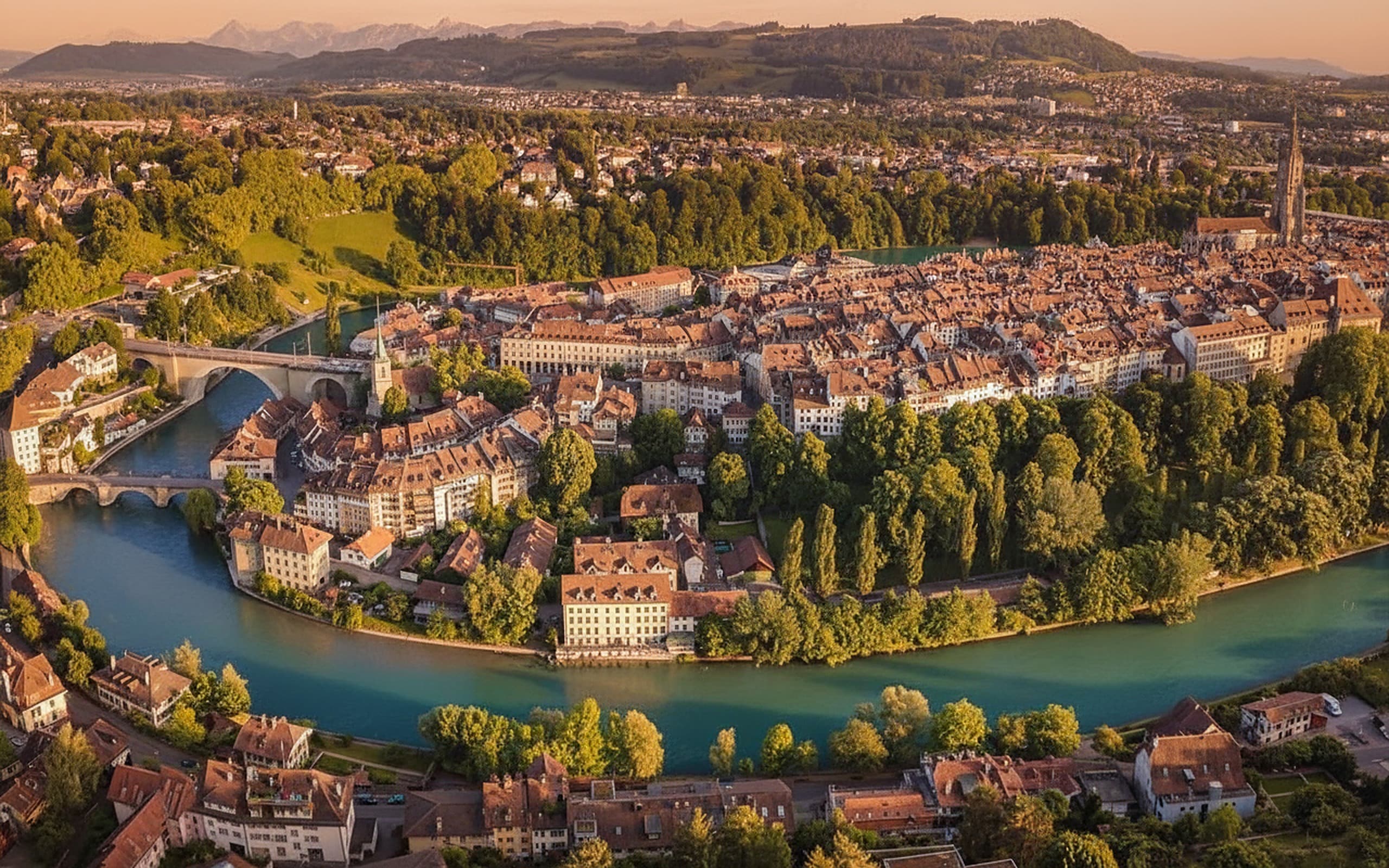
Berne est une ville qui se comprend mieux depuis les airs. La boucle de l'Aar qui entoure la vieille ville médiévale, l'alignement des collines, les Alpes au sud, depuis le cockpit, la géographie de la région prend sens en quelques secondes ce qui prendrait des heures à saisir depuis le sol.
La boucle de l'Aar
Le trait dominant de Berne depuis les airs est la boucle de l'Aar. La rivière décrit une courbe presque complète autour de la vieille ville, créant une péninsule naturelle sur laquelle Berne a été fondée au XIIe siècle. Depuis 2 000 pieds sur l'approche piste 32, la boucle est visible dans son intégralité, l'eau sombre entourant les toits de tuiles orangées, les ponts qui relient la péninsule au reste de la ville, le Palais fédéral sur le promontoire occidental.
La vieille ville médiévale
L'Altstadt de Berne est classé au patrimoine mondial de l'UNESCO. Depuis le cockpit, il se distingue clairement des développements plus récents : trame de rues serrée, toits uniformes, absences de gratte-ciel. Les arcades caractéristiques, les Lauben, créent un motif en grille visible depuis le dessus. La cathédrale de Berne, dont la flèche atteint 100 mètres, constitue un repère vertical utile lors des approches depuis le nord.
Gurten et la topographie
Le Gurten, colline à 864 mètres au sud-ouest de Berne, est visible depuis tout l'ouest lors des départs piste 32. Sa silhouette distinctive, sommet arrondi avec une tour de télécommunication, sert de repère d'orientation constant. La colline du Bremgarten borde la piste au nord. Le plateau du Bantiger ferme l'horizon à l'est. En comprenant ces reliefs, vous comprenez aussi pourquoi le circuit d'aérodrome est conçu comme il est.
La chaîne des Alpes
Par temps clair, depuis 3 000 pieds sur un départ piste 14, la chaîne alpine s'étend de gauche à droite sur tout le côté sud. Eiger, Mönch et Jungfrau sont reconnaissables même pour les non-pilotes. Pour un pilote en formation, cette vue n'est pas décorative, c'est de l'information : les crêtes enneigées signalent le niveau de gel, les formations nuageuses sur les versants nord indiquent le soulèvement orographique, l'absence de nuages au-dessus du terrain montagneux indique des conditions favorables aux vols de navigation vers le sud.
Ballenbühl et les zones d'entraînement
La zone d'entraînement principale utilisée par alpaviation est la zone Ballenbühl à l'est de l'aéroport. C'est ici que se pratiquent les manœuvres, décrochages, virages à grande inclinaison, VFR de précision. Depuis le cockpit, la limite de la zone est délimitée par les routes, les lignes électriques et les bords de forêt visibles. Connaître ces repères visuels depuis les airs est une compétence en soi, différente de les voir sur une carte.
La vallée de l'Aar vers le nord
Sur un départ vers le nord, la vallée de l'Aar s'étire jusqu'à l'horizon. Les villes de Soleure, Olten et Aarau sont alignées le long de la rivière. La centrale nucléaire de Mühleberg (maintenant déclassée) était un repère constant pendant des décennies, sa tour de refroidissement reste visible. Les lacs d'Aarburg et de Wohlen brillent par temps clair. Cette orientation nord est la première que la plupart des élèves apprennent, puis ils retournent vers le terrain montagneux au sud.
Le lac de Thoune et les lacs de l'Oberland
Au sud de Berne, le lac de Thoune et le lac de Brienz forment un axe aquatique entre les Alpes. Par temps clair, les deux lacs sont visibles depuis 5 000 pieds. Le lac de Thoune reflète le ciel différemment selon l'angle, profond bleu depuis le dessus, brillant argent depuis les côtés. Thun à l'extrémité nord du lac marque l'entrée dans l'Oberland bernois, le terrain montagneux commence là. Les pilotes de navigation de Berne-Belp vers Interlaken utilisent les lacs comme axe de guidage.
L'aéroport depuis les airs
L'approche piste 14 amène le pilote depuis le nord-ouest, descendant au-dessus de la ville de Belp avec la piste visible à travers le pare-brise. La piste 32 amène le pilote depuis le sud-est, avec le Gurten sur la gauche et les premières collines alpines derrière. Depuis le vent arrière piste 32, toute la boucle de l'Aar et l'Altstadt sont visibles à gauche, ce qui distrait les élèves jusqu'à ce qu'ils apprennent à l'ignorer et à se concentrer sur leurs instruments.
Repères de nuit
Berne de nuit depuis les airs est différente. La vieille ville est faiblement éclairée, l'architecture médiévale ressort davantage par les ombres que par les lumières. L'autoroute A1 en direction de Zurich est un ruban de phares visible à 30 km de distance. Les balises de l'aéroport, vert et blanc en alternance, sont visibles à 10 NM par nuit dégagée. Le Gurten disparaît dans l'obscurité mais son absence de lumières le rend identifiable comme une zone sombre sur fond de lumières de la ville.
Photographier Berne depuis le cockpit
Pour photographier Berne depuis les airs, quelques principes s'appliquent. Prenez vos photos en descente d'approche, pas dans le circuit, vous avez une meilleure altitude et distance de la piste. La meilleure lumière est le matin (soleil à l'est, éclairant le Palais fédéral et la vieille ville) ou en début de soirée (soleil à l'ouest, ombres dans les vallées). Évitez le milieu de journée quand le soleil est au-dessus et les ombres minimales. La boucle de l'Aar est la plus frappante quand la rivière est haute et l'eau sombre, d'avril à juin. L'automne apporte le paysage doré, mais la brume est plus fréquente. La clarté hivernale est excellente, mais l'angle bas du soleil peut être dur. Utilisez une vitre sans reflet. Un polarisant circulaire coupe la brume. Optez pour une pellicule rapide ou un ISO élevé, le cockpit est dans l'ombre par rapport au paysage lumineux dehors. La chaîne de l'Eiger est plus facile à photographier sur l'approche sud quand elle est en face de vous. La silhouette du Gurten est plus efficace à l'aube ou au crépuscule quand elle est en contre-jour. Et n'oubliez pas : votre première responsabilité est de piloter l'aéronef. L'appareil photo est secondaire.
Voyez-le par vous-même
Berne vue du ciel est saisissante. Mais ce n'est qu'une partie de ce qu'offre le vol depuis un aérodrome suisse. La formation est rigoureuse. La culture de sécurité est sans compromis. Les instructeurs sont des professionnels. Et la toile de fond, les Alpes, les vallées, la géographie, ne perd jamais de son intérêt. Si vous souhaitez obtenir votre licence dans un endroit qui vous challenge et vous inspire, alpaviation vous attend.
Commencez votre formation