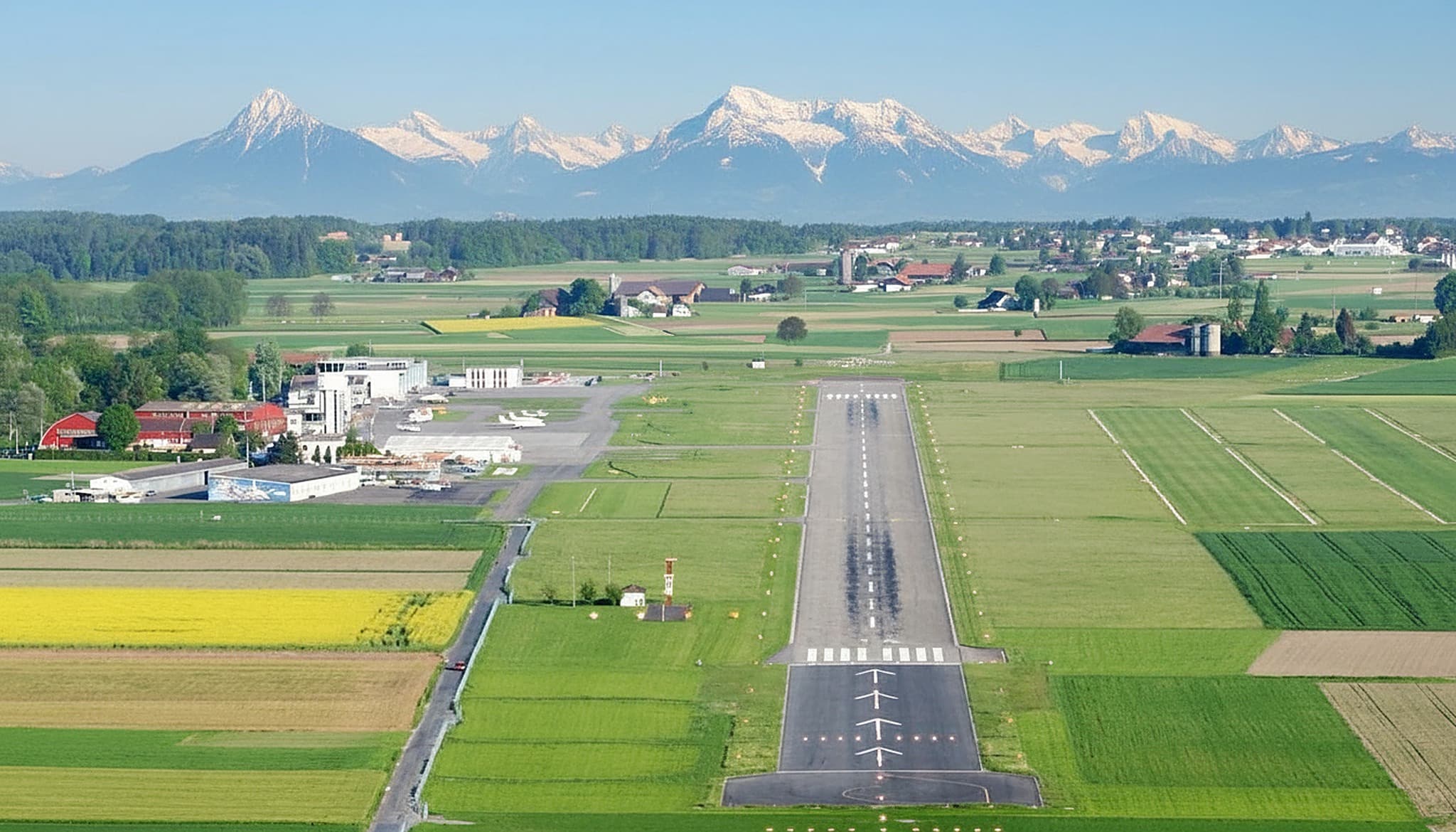
Bern-Belp Airport (ICAO: LSZB, IATA: BRN) sits 5 kilometres southeast of Bern in the commune of Belp, at 510 metres (1,674 feet) AMSL. A single paved runway, controlled airspace, instrument approaches, and a mountain backdrop make it a complete training environment.
Airport at a Glance
Runway 14/32: 1'730 metres by 30 metres, paved, headings 143/323 magnetic. Elevation 510m (1,674ft). Tower on 125.030 MHz. The airport handles approximately 50,000 movements annually, a mix of flight training, charter, business aviation, and REGA air ambulance operations. RNAV, VOR/DME, and NDB approaches are published for both runway directions. PAPI visual guidance on final.
History
Operational since 1929, Bern-Belp is one of Switzerland's oldest airfields. It evolved from a grass field into a modern paved facility while maintaining its character as a training and operations hub. alpaviation has operated here since 1988, holding EASA ATO certification (CH.ATO.0147) and training hundreds of pilots under the EASA framework.
Runway and Performance
The 1,730m runway presents no constraints for training aircraft (Cessna 172, Bristell B23, Diamond DA42). The surface is well-maintained asphalt with appropriate lighting for night operations. At 510m elevation, density altitude is moderate but should be verified using the POH during high-temperature operations. Pilots should consult current NOTAM, METAR, and wind conditions to determine the active runway.
Controlled Airspace and ATC
LSZB sits within the Bern Control Zone (CTR), requiring radio contact and clearance prior to entry. Tower controls traffic during operational hours. VFR arrivals use designated entry points with standard left-hand circuits at 1,000 feet above aerodrome elevation. All radio telephony is conducted in English or French per Swiss regulations. The real-world ATC environment develops communication skills and situational awareness far more effectively than a quiet uncontrolled field.
Instrument Approaches
RNAV (GPS) approaches to both runways provide precision guidance in low-visibility conditions. VOR/DME approaches offer traditional radio navigation. An NDB approach is available for ADF-equipped aircraft. This variety makes LSZB an excellent venue for instrument rating preparation, students practice different navigation disciplines in a real operational environment. Even poor-weather days become instrument approach practice opportunities.
The Alpine Setting
From the apron, the Stockhorn (2,190m) rises to the south, followed by the Niesen (2,362m) and the Gantrisch massif. The Gürbetal valley's green farmland surrounds the runway. This terrain demands respect. Weather systems develop rapidly in the valley, and wind patterns near the runway can be influenced by valley effects. For training purposes, the Alpine setting provides mountain awareness and terrain evaluation skills from the earliest stages.
Why LSZB is Ideal for Training
Active controlled airfield with genuine ATC and mixed traffic. Variety of instrument approach procedures. Alpine setting teaching mountain awareness from day one. 38 years of alpaviation institutional knowledge of local conditions. Infrastructure meeting international standards. Pilots trained here operate in a realistic environment from their first solo.
Year-Round Operations
Winter temperatures range from -5 to +5 degrees Celsius, requiring cold-weather procedures. Spring and autumn offer stable conditions ideal for cross-country training. Summer brings higher density altitude and afternoon thunderstorm potential. The availability of instrument approaches means low-ceiling days become IFR training opportunities rather than lost days.
Planning Your Visit
File a flight plan if crossing borders or flying in controlled airspace. Contact Bern Approach before entering the CTR. Monitor ATIS for current conditions. Tie-down facilities and fuel (Jet A-1, AVGAS) are available. Ground transport to Bern city centre takes 20 minutes by bus.
Train at Bern-Belp
alpaviation offers EASA-certified flight training from PPL(A) to ATPL(A) at Bern-Belp Airport. Contact us to discuss your aviation goals.
Contact Us