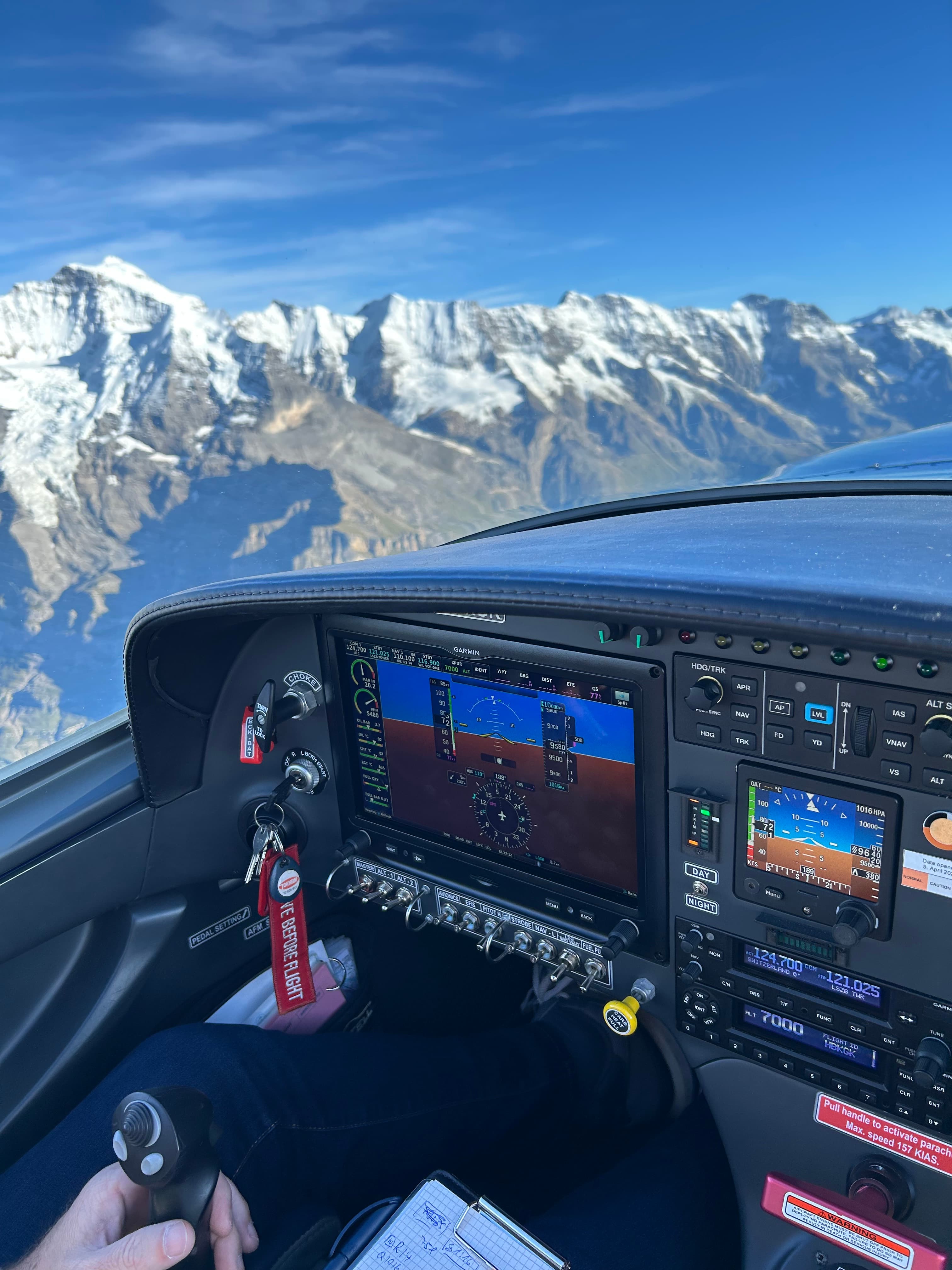
You already know what you want to fly. Maybe it's a 747 across the Pacific, or a Super Cub onto a glacier strip, or a helicopter pulling someone off a mountain. The question isn't what, it's how. This guide maps every aviation career path back to the training that gets you there.
Commercial
Airline Captain
Day in the life
You arrive at the airport two hours before departure, brief your first officer on weather, NOTAMs, and fuel planning, then command an aircraft carrying hundreds of passengers across continents. Every day is a different city, a different set of conditions, and a different crew. The job demands total systems mastery, crew leadership under pressure, and the ability to make sound decisions at 37,000 feet with incomplete information.
Licences and ratings
- -PPL(A)
- -Night Rating
- -Instrument Rating
- -Multi-Engine Piston
- -CPL(A)
- -ATPL(A) (Frozen or Full)
- -Type Rating
Timeline from zero
5 to 8 years from first flight to airline first officer seat; captain upgrade typically requires 1,000 to 3,000 further hours in type
How alpaviation fits
alpaviation provides the foundational licences and ratings, PPL(A), Night, IR(A), MEP, and CPL(A), that form the base of every airline career. The modular pathway means you can build each qualification around your schedule.
Cargo Pilot
Day in the life
You fly at night, often alone, on tight schedules that keep supply chains moving. The cargo world is less glamorous than passenger operations but rewards pilots who prefer autonomy over routine. Night-freight runs on piston twins build hours fast; widebody cargo captains fly the same equipment as the biggest airlines, just without passengers.
Licences and ratings
- -PPL(A)
- -Night Rating
- -Instrument Rating
- -Multi-Engine Piston
- -CPL(A)
Timeline from zero
3 to 5 years from first flight to entry-level cargo co-pilot
How alpaviation fits
The CPL(A) with Night Rating and IR(A) from alpaviation is the standard entry ticket for cargo operators. Night currency built during training directly translates to the cargo environment.
Charter Pilot
Day in the life
Each morning you check the manifest, it could be a family flying to a ski resort, a business executive on a tight connection, or a medical patient transfer. Charter flying demands flexibility, strong passenger handling, and the instrument skills to operate in European weather year-round. Routes change daily; no two weeks are the same.
Licences and ratings
- -PPL(A)
- -Night Rating
- -Instrument Rating
- -Multi-Engine Piston
- -CPL(A)
Timeline from zero
3 to 5 years from first flight to charter co-pilot seat
How alpaviation fits
alpaviation's CPL(A) pathway covers every rating charter operators require. The Swiss Alps environment also builds genuine terrain-awareness skills that are directly valued in alpine charter operations.
Corporate Jet Pilot
Day in the life
You operate high-performance jets for corporations and high-net-worth clients, often as a small two-person crew. Schedules are driven by the client, which means early starts, late notices, and discretion in sensitive environments. The aircraft are technically complex and the standard is uncompromising. Corporate aviation rewards meticulous preparation and quiet professionalism.
Licences and ratings
- -PPL(A)
- -Instrument Rating
- -Multi-Engine Piston
- -CPL(A)
- -Type Rating (jet)
Timeline from zero
4 to 6 years from first flight to co-pilot seat on a light or mid-size jet
How alpaviation fits
The CPL(A) with IR(A) and MEP from alpaviation is the standard foundation. A type rating on a PC-12 or similar high-performance single is an ideal bridge to jet operations and is available through alpaviation's curriculum.
VIP Transport Pilot
Day in the life
Your passengers include heads of state, senior executives, and their families. Every flight is a high-discretion event where timeline precision and cabin environment are as important as the technical flying. You manage the entire operation, fuelling, handling, customs, ground transport coordination, in addition to flying the aircraft.
Licences and ratings
- -PPL(A)
- -Instrument Rating
- -Multi-Engine Piston
- -CPL(A)
- -Type Rating
Timeline from zero
4 to 6 years from first flight, with additional years building the hours and reputation that VIP operators require
How alpaviation fits
alpaviation's CPL(A) pathway and advanced handling curriculum build the technical base. The professional standards taught from day one in Switzerland's demanding airspace prepare pilots for the precision VIP operations demand.
Ferry Pilot
Day in the life
You fly aircraft from their point of sale or manufacture to their new home, across oceans, across continents, through unfamiliar airspace, often in aircraft you've never flown before. Each delivery is a self-contained expedition: unfamiliar avionics, long overwater legs, fuel-range planning to the litre. The work is irregular, often solo, and demands genuine aeronautical self-sufficiency.
Licences and ratings
- -PPL(A)
- -Night Rating
- -Instrument Rating
- -Multi-Engine Piston
- -CPL(A)
Timeline from zero
3 to 5 years from first flight; ferry work typically comes after building 500 to 1,000 hours on varied aircraft
How alpaviation fits
A solid PPL(A) and CPL(A) foundation from alpaviation, combined with genuine Alps cross-country experience, builds the navigation and decision-making skills that ferry flying depends on.
Emergency
Air Ambulance Pilot
Day in the life
You fly medical teams to patients and patients to definitive care, often in deteriorating weather, at short notice, into non-standard sites. The pressure is real: the aircraft is an operating platform and your decisions directly affect clinical outcomes. Air ambulance pilots combine instrument precision with the judgement to refuse a flight that a less experienced crew might accept.
Licences and ratings
- -PPL(A)
- -Night Rating
- -Instrument Rating
- -CPL(A)
- -Advanced Handling
Timeline from zero
4 to 6 years from first flight; most operators require 1,000 to 2,000 hours before first air ambulance role
How alpaviation fits
The Night Rating, IR(A), and CPL(A) from alpaviation form the core of the air ambulance pathway. Advanced handling training in the Alps provides the mountain-environment skills that Swiss and Austrian operators specifically value.
Search and Rescue Pilot
Day in the life
You launch at night or in storms when other flights are grounded. SAR missions range from mountain rescues in zero visibility to maritime searches covering hundreds of square miles. The role demands technical mastery, crew coordination with specialist rescue teams, and the psychological composure to operate in environments that are inherently unpredictable.
Licences and ratings
- -PPL(A)
- -Night Rating
- -Instrument Rating
- -CPL(A)
- -Advanced Handling
Timeline from zero
4 to 6 years from first flight; most SAR roles (military or civilian) require 1,500 to 2,500 hours
How alpaviation fits
The IR(A) and advanced handling elements of alpaviation's curriculum are directly aligned with what SAR operators look for. Alpine mountain flying experience is a genuine differentiator for candidates applying to Swiss SAR programmes.
Firefighting Pilot
Day in the life
You operate scooping aircraft or tankers at low altitude in high-heat environments, coordinating with ground teams fighting active fires. It is high-workload, low-altitude flying that demands precise aircraft handling and rapid situational assessment. The season is intense, typically summer months, with long duty days and demanding terrain.
Licences and ratings
- -PPL(A)
- -CPL(A)
- -Advanced Handling
Timeline from zero
3 to 5 years from first flight; operators typically require 500 to 1,000 hours on appropriate aircraft types
How alpaviation fits
alpaviation's PPL(A) and CPL(A) pathway combined with advanced handling training builds the precision low-altitude skills that aerial firefighting demands. Swiss training in complex terrain is a direct advantage.
Law Enforcement Pilot
Day in the life
You fly surveillance, pursuit, and support operations for police and border agencies. Missions include vehicle pursuits, crowd monitoring, border patrol, and tactical support. The flying is often at low levels, in congested airspace, at night, with sensor operators and tactical officers in the back. Decision-making under ambiguity is a core requirement.
Licences and ratings
- -PPL(A)
- -Night Rating
- -Instrument Rating
- -CPL(A)
Timeline from zero
3 to 5 years from first flight; many law enforcement agencies require candidates to come with an existing CPL(A) and instrument rating
How alpaviation fits
The CPL(A) pathway with Night Rating and IR(A) from alpaviation provides the licence base most law enforcement agencies require at application. Swiss precision and airspace literacy are valued across European policing operations.
Specialist
Agricultural Pilot
Day in the life
You fly at low altitude over crops, applying products with precision across large fields before the wind picks up. Agricultural flying is technically demanding, low-level obstacle avoidance, consistent application swaths, and precise GPS track management, but operationally straightforward once the skills are established. It is physical, outdoor, and largely independent work.
Licences and ratings
- -PPL(A)
- -CPL(A)
Timeline from zero
2 to 4 years from first flight to first agricultural operator role; most operators require 300 to 500 hours
How alpaviation fits
The PPL(A) and CPL(A) from alpaviation cover the regulatory baseline. The low-level precision flying skills developed in the Alps environment provide a strong foundation for the handling demands of agricultural operations.
Aerial Survey Pilot
Day in the life
You fly systematic grid patterns at defined altitudes while sensor systems below map terrain, pipelines, power lines, or agricultural land. The flying itself is highly disciplined, the data quality depends entirely on your ability to hold altitude, track, and speed within tight tolerances for hours at a time. It is methodical, technical, and important work.
Licences and ratings
- -PPL(A)
- -Instrument Rating
- -CPL(A)
Timeline from zero
3 to 4 years from first flight; survey operators typically require an IR(A) and 500 to 1,000 hours
How alpaviation fits
The PPL(A) and CPL(A) with Instrument Rating from alpaviation directly matches the profile survey operators recruit. Systematic precision flying, the core of the alpine training environment, is exactly what this role demands.
Parachute Drop Pilot
Day in the life
You fly repeated circuits, climbing to altitude and dropping skydivers at a precise exit point each time. The duty day is long and repetitive, dozens of circuits in a single day is normal, but the community is tight-knit and the flying environment is social. Parachute operations require good awareness of the jump run, wind, and exit timing.
Licences and ratings
- -PPL(A)
- -CPL(A)
Timeline from zero
2 to 3 years from first flight; most drop zones hire at around 200 to 500 hours
How alpaviation fits
alpaviation's PPL(A) and CPL(A) pathway provides the licence base. The short-field and circuit precision skills developed in Swiss alpine training are well-suited to the repetitive, precision-oriented nature of drop zone operations.
Aerial Advertising Pilot
Day in the life
You tow banners, pull smoke trails at airshows, or operate aerial photography platforms for marketing campaigns. The work is seasonal, often local, and highly visual. Banner towing requires precise low-level handling and grappling hook technique; smoke work at airshows demands display flying skills and tight coordination with event organisers.
Licences and ratings
- -LAPL(A) or PPL(A)
- -CPL(A)
Timeline from zero
2 to 4 years from first flight; niche work that typically requires referrals and a solid local flying reputation
How alpaviation fits
alpaviation's training through LAPL(A) or PPL(A) to CPL(A) covers the full licence progression. The small-field and precision flying skills built in Switzerland are directly applicable to the handling demands of aerial advertising operations.
Seaplane Pilot
Day in the life
You operate from lakes, rivers, and coastal waters, landing on surfaces that change with weather, current, and boat traffic. Seaplane flying is operationally distinct from land-based flying: water landings, docking, and handling in crosswind conditions require a specific skill set. The environments are often spectacular, remote Canadian lakes, Maldivian atolls, Norwegian fjords.
Licences and ratings
- -PPL(A)
- -Seaplane Rating
Timeline from zero
1 to 2 years from first flight to seaplane rating; commercial seaplane work requires a CPL(A) in addition
How alpaviation fits
alpaviation provides the PPL(A) foundation. The seaplane rating is a specialised add-on typically pursued once the PPL(A) is established; alpaviation's team can advise on approved providers and route the training efficiently.
Teaching
Flight Instructor
Day in the life
You spend your days in the right seat, guiding students through their first circuits, their first solo, and their first instrument approaches. Instructing demands a different kind of discipline, you must manage two cognitive loads simultaneously: flying the aircraft and monitoring your student's performance. Good instructors are built on technical clarity, patience, and the ability to communicate under pressure.
Licences and ratings
- -PPL(A)
- -Night Rating
- -Instrument Rating
- -CPL(A)
- -Flight Instructor Certificate (FI)
Timeline from zero
3 to 4 years from first flight to first FI post; the FI course follows the CPL(A) and typically takes 4 to 6 months
How alpaviation fits
alpaviation offers the full pathway from PPL(A) through CPL(A) to FI certificate. Instructors trained here gain their ratings in one of Europe's most demanding training environments, an advantage when applying to flight schools across the continent.
Flight Examiner
Day in the life
You conduct skill tests and proficiency checks that determine whether pilots meet the regulatory standard to hold their licences. Examiners must be precise, impartial, and deeply knowledgeable, you are the final quality gate in the system. The role requires authority designation from the national aviation authority and carries significant professional responsibility.
Licences and ratings
- -PPL(A)
- -Instrument Rating
- -CPL(A)
- -Flight Instructor Certificate (FI)
- -Examiner Authorisation
Timeline from zero
6 to 10 years from first flight; examiner authorisation requires substantial instructing experience and is awarded selectively
How alpaviation fits
alpaviation's FI pathway provides the instructing base from which examiner candidates develop. The school's relationship with Swiss FOCA and EASA processes is a direct resource for those pursuing examiner authorisation.
Chief Pilot
Day in the life
You hold the Accountable Manager post for an AOC holder or flight school, responsible for the standard of every flight conducted under your operational approval. The role is predominantly administrative: standards management, crew qualification oversight, liaison with the national authority, and investigation of incidents. You still fly, but the job is as much management as it is aviation.
Licences and ratings
- -PPL(A)
- -Instrument Rating
- -CPL(A)
- -Flight Instructor Certificate (FI)
Timeline from zero
6 to 10 years from first flight; chief pilot appointments require extensive operational and instructing experience
How alpaviation fits
alpaviation's CPL(A) and FI pathway builds the technical and instructional base. For pilots with leadership ambitions, the operational management exposure available at a flight school provides the most direct route to a chief pilot role.
Aviation Academy Founder
Day in the life
You build the institution, recruiting instructors, managing the fleet, navigating regulatory approvals, and marketing to students. An academy founder is simultaneously a business operator and an aviation professional. The most successful ones combine genuine instructing experience with commercial clarity about what students need and what the market will support.
Licences and ratings
- -PPL(A)
- -CPL(A)
- -Flight Instructor Certificate (FI)
Timeline from zero
5 to 10 years of operational and instructing experience is the typical base before founding a school; the regulatory process for an ATO approval adds 1 to 2 years
How alpaviation fits
alpaviation itself is an example of this archetype executed at a high level, the school's modular, student-centred model is worth studying for anyone considering building an aviation training organisation.
Adventure
Bush Pilot
Day in the life
You operate into strips that are not in any database, unprepared surfaces, short clearings, high-altitude meadows, carrying cargo, passengers, or scientific teams to places that have no other access. Bush flying is the purest expression of pilot skill: no ATC, no ILS, no go-around guarantee. You read the terrain, read the aircraft, and make the call.
Licences and ratings
- -PPL(A)
- -CPL(A)
- -Advanced Handling
Timeline from zero
3 to 5 years from first flight; most bush operators expect 300 to 1,000 hours before hiring, built on varied terrain
How alpaviation fits
alpaviation's Swiss Alps environment is one of the best in Europe for developing the terrain awareness and judgement that bush flying demands. Advanced handling training here builds skills that translate directly to unprepared-strip operations worldwide.
Expedition Pilot
Day in the life
You support scientific, documentary, or geographic expeditions in remote environments : Antarctica, high mountain ranges, desert plateaux. The flying combines technical challenge with genuine exploration. Logistics management is as important as the piloting: fuel caches, permits, weather windows, and contingency planning for environments where rescue may be days away.
Licences and ratings
- -PPL(A)
- -Night Rating
- -CPL(A)
- -Expedition Flying experience
Timeline from zero
3 to 5 years from first flight, followed by deliberate hour-building in remote and challenging terrain
How alpaviation fits
alpaviation's mountain flying curriculum and cross-country expedition experience in the Alps builds the navigational and self-reliance skills that expedition operations require. This is one of the best geographic training environments in Europe for this archetype.
Aerobatic Pilot
Day in the life
You fly precision manoeuvres, loops, rolls, hammerheads, snap rolls, to a choreographed sequence within a defined box of airspace. Aerobatic flying demands exceptional spatial awareness, precise throttle and control input coordination, and the physical conditioning to manage G forces repeatedly over a display or contest flight. The skill takes years to develop and rewards obsessive attention to aircraft control.
Licences and ratings
- -PPL(A)
- -Aerobatic Rating
Timeline from zero
1 to 3 years from PPL(A) to first aerobatic rating; competition-level flying typically requires 2 to 5 years of dedicated training beyond that
How alpaviation fits
Le PPL(A) d'alpaviation fournit les bases. alpaviation ne délivre pas de qualifications de voltige ; l'équipe peut vous orienter vers des prestataires de formation voltige agréés une fois votre PPL(A) et vos heures post-licence en place.
Glider Pilot
Day in the life
You soar on thermals and ridge lift, covering hundreds of kilometres without an engine. Glider flying is the most energy-efficient form of aviation and arguably the most demanding in terms of weather reading and airspace awareness. Cross-country gliding in the Alps means routing through complex terrain, managing altitude carefully, and making field-landing decisions well in advance.
Licences and ratings
- -LAPL(A) (Sailplane) or SPL
Timeline from zero
6 to 18 months from first flight to solo and basic LAPL(A)(S); cross-country capability takes 1 to 3 years of regular flying
How alpaviation fits
alpaviation provides the LAPL(A) pathway that underpins glider progression. The Swiss Alps are one of the most distinctive soaring environments in the world, the mountain wave and ridge systems around alpaviation's operating area are demanding training terrain.
Competition Pilot
Day in the life
You fly a defined sequence or course against a scored standard, aerobatic contests, precision landing events, cross-country air racing. Every flight produces a score, and the score tells you exactly where the work is. Competition flying is self-correcting by nature: you either improve or you do not progress. The discipline required is mental as much as physical.
Licences and ratings
- -PPL(A)
- -Aerobatic Rating
- -Advanced Handling
Timeline from zero
2 to 4 years from PPL(A) to first competitive participation; national or international-level competition typically requires 3 to 6 years beyond that
How alpaviation fits
Le PPL(A) et la formation au pilotage avancé dans les Alpes chez alpaviation fournissent les bases du vol de précision. Les qualifications de voltige et de compétition ne sont pas délivrées chez alpaviation ; l'équipe peut vous orienter vers des prestataires agréés le moment venu.
Emerging
Drone Operations Director
Day in the life
You manage the integration of unmanned systems into complex operations, managing EASA UAS authorisations, coordinating with national authorities, and overseeing flight crews operating in urban, industrial, and controlled airspace environments. The role sits at the intersection of manned aviation knowledge and emerging technology regulation. It is a leadership position as much as a technical one.
Licences and ratings
- -PPL(A) or equivalent
- -Advanced Ratings
- -UAS operational authorisation knowledge
Timeline from zero
2 to 4 years from first flight to entry-level UAS operational role; director-level positions typically require 5 or more years of aviation and management experience
How alpaviation fits
A PPL(A) from alpaviation provides the manned aviation literacy that UAS directors increasingly need, airspace awareness, meteorology, and operations management built in real-world conditions. This background is a direct differentiator in the UAS sector.
Test Pilot
Day in the life
You fly prototype or modified aircraft at the edges of their certificated envelope, documenting handling characteristics, validating performance figures, and identifying deficiencies before production. Each flight is a planned experiment. You brief the programme, fly the test points, debrief the data, and write the report. Test flying demands the highest level of technical knowledge and psychological discipline in aviation.
Licences and ratings
- -PPL(A)
- -Night Rating
- -Instrument Rating
- -CPL(A)
- -Advanced Handling
- -High Performance Aircraft
Timeline from zero
6 to 10 years from first flight; formal test pilot school entry typically requires 1,000 to 1,500 hours and a demonstrated academic record
How alpaviation fits
alpaviation's full CPL(A) pathway with Night Rating, IR(A), and advanced handling ratings provides the licence base. The technical rigour and high-performance single-engine environment at alpaviation is an ideal stepping stone toward test pilot school selection.
Ready to Start?
Talk to our training team about the first step on your path, whether that's a discovery flight or a full licence plan.
Get in Touch