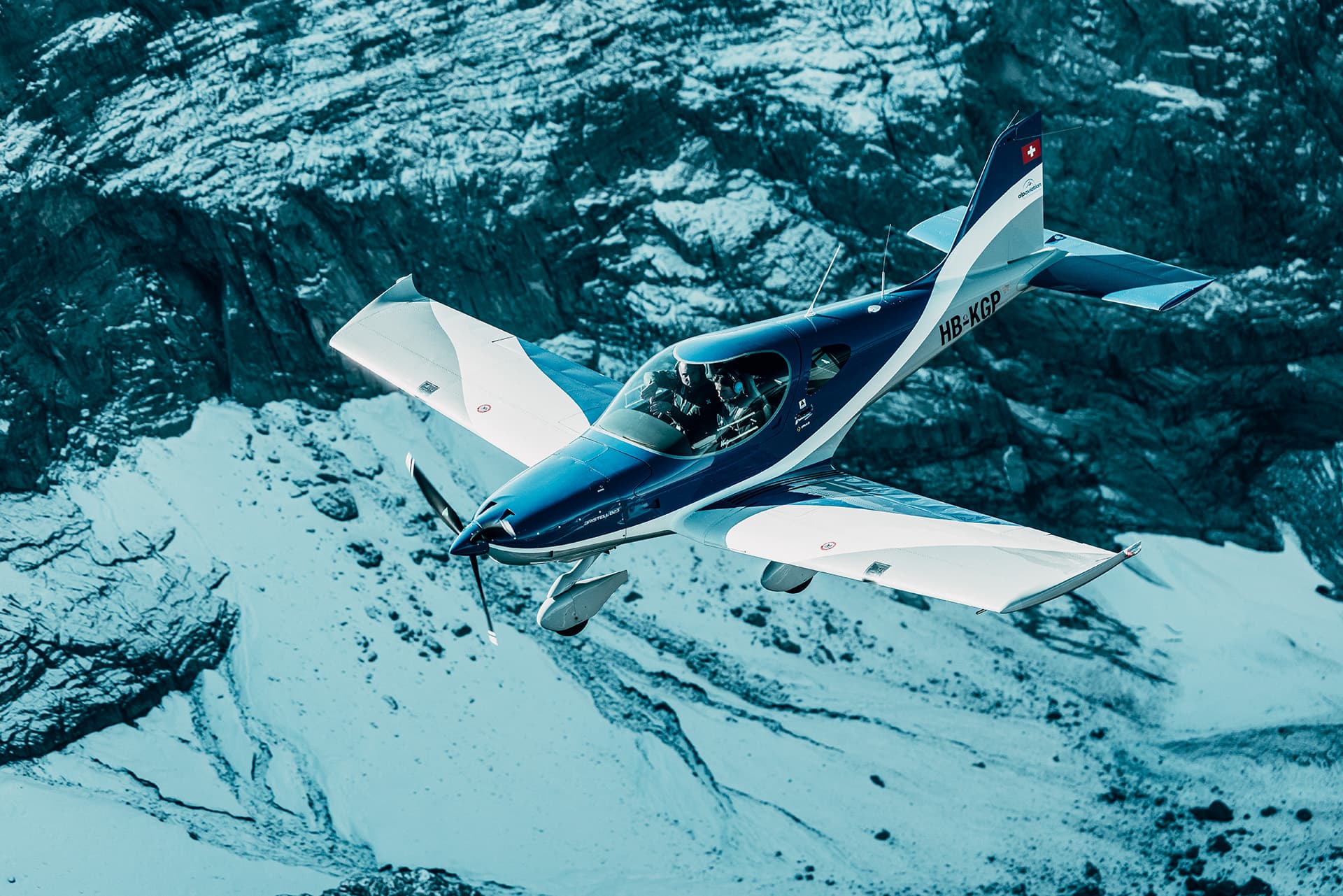
Switzerland offers EASA pilot training with real alpine experience, training available in English, and licences valid across Europe. Swiss pilot training began in Bern: in 1914, cavalry officer Theodor Real trained the country's first nine pilots on a makeshift airfield at Beundenfeld, before the young flying corps moved to Dübendorf. More than a century later, new pilots still learn to fly at Bern-Belp, a short flight from where it all began.
1. Airspace and infrastructure
Switzerland has more than 60 airfields in a country of just 41,285 km². That density means you are never far from a different airport, a different approach, a different procedure. The infrastructure is modern, well-maintained, and consistently reliable. Bern-Belp (LSZB), where alpaviation is based, offers Class D controlled airspace, a full ILS approach, and active ATC.
- Dozens of airfields within training range: every type of airport operation
- Bern-Belp: Class D airspace, ILS approach, active tower
- Modern navigation aids everywhere: ILS, VOR, GNSS/RNAV
- Zurich and Geneva within a short training flight: international airport experience within reach
2. The Swiss safety mindset
Swiss aviation culture treats safety as non-negotiable. FOCA, the Federal Office of Civil Aviation, applies rigorous, consistently enforced oversight, and this filters down to every ATO, every maintenance organisation, every flight. You learn checklists, SOPs, and documentation: the habits that keep pilots alive for 40 years of flying.
- FOCA oversight: rigorous and consistently enforced
- Rigorous maintenance intervals, enforced consistently
- Safety management systems are mandatory for every Swiss ATO
- Precision culture extends into every training flight
3. Flying in the Alps
Swiss training puts you in mountain airspace from your early lessons. You fly around, over, and through demanding alpine terrain, learn to read valley wind, identify föhn conditions, respect mountain wave, and make real weather decisions in real terrain. Pilots who train here carry that judgement everywhere they fly.
- Real mountain flying from the earliest lessons: it comes with the terrain
- Föhn winds, valley effects, mountain wave awareness built into training
- Weather decision-making in terrain that forces respect
- A living tradition: Swiss pilots pioneered glacier landings in the Alps
4. EASA recognition across Europe
Switzerland has been fully integrated into the EASA system since 2006. That means every licence, rating, and endorsement earned in Switzerland is valid in all 27 EU member states plus Norway, Iceland, and Liechtenstein, with no conversion needed. Your PPL(A), CPL(A), IR(A), MEP, or type rating moves with you across Europe the moment you need it to.
- Licences valid in all 27 EU states + EEA: no conversion
- PPL(A), CPL(A), IR(A), MEP, and type ratings all portable
- Standards identical to Germany, France, Italy: Swiss delivery
- ICAO-compliant and harmonised with the global framework
5. Training available in English
English is widely used in Swiss aviation: IFR operations run in English, and English-language ATC is available at every controlled airport. Training is available in English, and theory exams can be taken in English, German, French, or Italian. Daily use of aviation English supports the ICAO English Level 4 endorsement that EASA requires for radio use (FCL.055).
- English ATC at every controlled airport: Bern-Belp, Zurich, Geneva
- Training available in English
- Theory exams offered in English, German, French, or Italian
- Daily use of aviation English supports the ICAO Level 4 endorsement EASA requires (FCL.055)
6. Weather diversity makes better pilots
A single training cycle in Switzerland exposes you to four seasons, alpine microclimates, valley fog, crosswinds, thermals, lake effects, and föhn. You train to decide when to fly, when to divert, and when to stay on the ground.
- Four seasons inside a single training cycle
- Alpine microclimates teach real weather assessment
- Valley fog, crosswinds, thermals, föhn: all standard conditions
- Better decision-making carries into your entire flying career
7. Every airspace class, short flights
A 30-minute flight in Switzerland can take you through Class G uncontrolled airspace, Class D at Bern-Belp, Class C in Geneva or Zurich TMA, gliding sectors, military zones, and restricted areas. This procedural variety is rare. In many countries you have to plan a long navigation to encounter half of it. Here it is a normal training sortie.
- Class G → D → C within 30 minutes of flight
- Military zones, gliding sectors, restricted areas: real planning required
- Cross-border procedures to France, Germany, Italy, Austria
- Procedural exposure that prepares you for any operation
8. Swiss aviation career ecosystem
Switzerland is home to SWISS International Air Lines, Helvetic, Edelweiss, and Chair Airlines. Geneva and Zurich rank among Europe's top business aviation hubs. There are rotary operators, medical and mountain rescue services, glacier pilots: specialist career paths that do not exist in most countries. Training here positions you inside that ecosystem.
- SWISS, Helvetic, Edelweiss, Chair: domestic carrier pathways
- Geneva and Zurich: two of Europe's largest business aviation hubs
- Specialist paths: rotary, medical, glacier, mountain rescue
- Rega development programme: the Swiss air rescue supports selected young helicopter pilots
9. International students welcome
Non-EU candidates can apply for a student visa (L permit) for training stays, and EU/EFTA citizens train without a visa. The EASA licence conversion framework accepts FAA and ICAO third-country licences. FOCA, the Swiss aviation authority, publishes in German, French, Italian, and English. You can plan a realistic path from wherever you are starting.
- L permit (student visa) available for non-EU applicants
- EASA conversion from FAA and ICAO 3rd-country licences supported
- Multilingual admin: DE, FR, IT, EN: for clear processes
- EU/EFTA citizens: no visa needed to train in Switzerland
10. Quality of life
None of the above matters if you burn out during training. A quarter-hourly bus links Bern Airport to the rail network, and daily life runs on schedule. The country works, and that reliability extends to your ability to focus, train, and progress.
- Reliable public transport and infrastructure
- Reliable public transport: no car needed to reach training
- Healthcare and environment reduce lost training days
- Lifestyle that supports sustained focus and progress
A Swiss licence is an EASA licence, valid across Europe from the day it is issued. The flying behind it is alpine terrain, four seasons of weather, and every airspace class within a 30-minute flight.
Frequently asked questions
Can foreigners train as pilots in Switzerland?
Yes. Non-EU candidates can apply for a student visa (L permit) for training stays, and EU/EFTA citizens train without a visa. Training is available in English, and the EASA framework accepts FAA and other ICAO licences for conversion.
Is a Swiss pilot licence valid in the EU?
Yes. Switzerland has been part of the EASA system since 2006, so a licence earned in Switzerland is valid in all 27 EU member states plus Norway, Iceland, and Liechtenstein, with no conversion needed.
Do I need to speak German to train as a pilot in Switzerland?
No. Training is available in English, theory exams can be taken in English, IFR flying runs in English, and English ATC is available at every controlled airport.
How long does it take to get a private pilot licence (PPL) in Switzerland?
The EASA PPL(A) requires at least 45 flight hours. How long that takes depends on how frequently you fly.
Ready to train in Switzerland?
Arrange a discovery flight at Bern-Belp. See the country, the aircraft, and the training environment for yourself.
Request a discovery flight