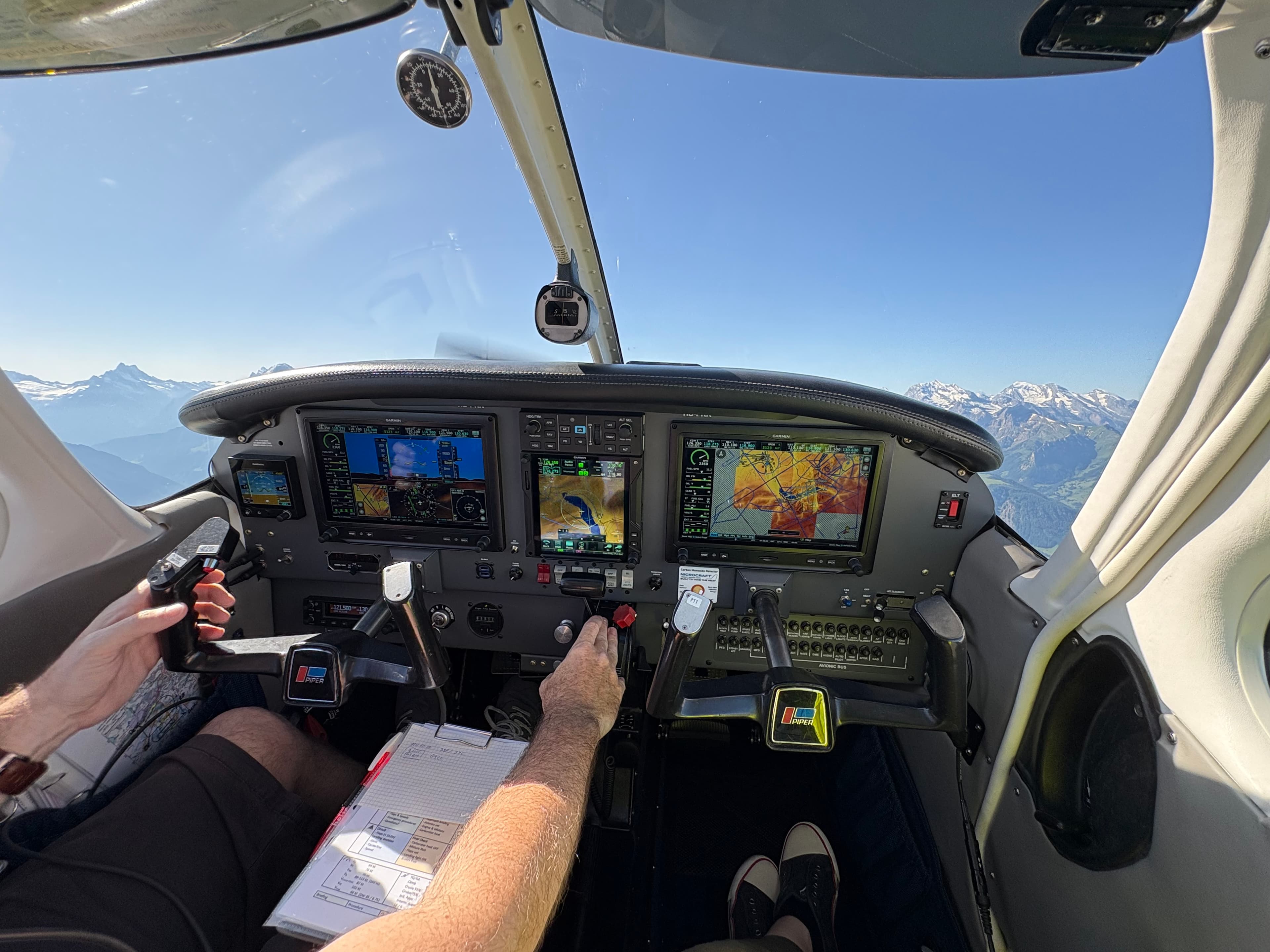
A pilot licence sets out which aircraft you may fly and in which crew position, and a rating extends that authority to specific conditions, classes or types of aircraft. Licences, ratings, type ratings and endorsements are each a distinct qualification, and together they define exactly what you may legally do in an aircraft, under the EASA regulations that govern aviation across Europe.
What is a pilot licence?
A pilot licence is your foundational qualification. It is issued by your national aviation authority (in Switzerland, the FOCA) and sets out which aircraft you may fly and in which crew position, as pilot in command or as co-pilot. In Part-FCL each aeroplane licence has its own subpart: B for the LAPL(A), C for the PPL(A), D for the CPL(A), E for the Multi-crew Pilot Licence (MPL) and F for the ATPL(A).
Each licence represents a different level of authority and responsibility. A Private Pilot Licence (PPL(A)) allows you to fly in non-commercial operations without remuneration; a holder with instructor or examiner privileges may be paid for LAPL(A) and PPL(A) instruction and testing (FCL.205.A). A Commercial Pilot Licence (CPL(A)) is the first professional licence, with privileges that include commercial air transport (FCL.305). An Airline Transport Pilot Licence (ATPL(A)) qualifies you to be captain of an airliner. The LAPL(A) is the simplest: limited to light aircraft, good visibility, and daytime flying. Your licence is the foundation. Everything else builds on top of it.
What is a rating?
A rating extends the authority granted by your licence. It permits you to operate under specific conditions or in specific classes or types of aircraft. Common ratings include:
- -Instrument Rating (IR(A)): allows you to fly under instrument flight rules, including PBN operations, with a decision height of no less than 200 feet (FCL.605)
- -Night Rating: permits you to fly under VFR at night (FCL.810), the period between the end of evening civil twilight and the beginning of morning civil twilight
- -Multi-Engine Piston (MEP): a class rating for multi-engine piston aeroplanes, issued separately as MEP(land) and MEP(sea)
- -Mountain Rating: permits flights to and from surfaces designated by the authorities as requiring it, on wheels when they are free of snow or on skis when they are covered
What is a type rating?
A type rating is specific to an individual aircraft model. Some aircraft are complex or capable enough that a separate qualification for that type alone is required.
Type ratings are required for aeroplanes outside the class ratings. They involve dedicated ground school, simulator training, and a final skill test. Single-engine turboprop (SET) aeroplanes can be covered by a class rating (FCL.710(c)(1)(iv)), revalidated by a proficiency check with an examiner, but a complex single-pilot aeroplane classified as high-performance needs a type rating (FCL.720.A(a)(3)). Once you hold a type rating, you can operate that aircraft type, but only if your licence and other ratings permit it. A PPL(A) holder flies that type within the PPL(A) privileges (FCL.205.A); a night rating adds VFR flight at night (FCL.810) and an instrument rating adds IFR flight (FCL.605).
What is an endorsement?
In GM1 FCL.700, EASA lists each class rating under the heading 'Licence Endorsement', while type ratings appear in a separate list that EASA publishes; EASA rules also use the word for language proficiency and PBN privileges. Within a class rating, moving to a variant such as a tailwheel undercarriage, a retractable undercarriage, a turbocharged engine, cabin pressurisation or EFIS calls for differences training. For SEP, MEP and TMG aeroplanes an appropriately qualified instructor may give it, and it is entered in your logbook and signed.
How they work together
Think of your qualifications as a hierarchy. Your licence is the foundation. Your ratings extend what your licence allows. Type ratings and endorsements add specific capabilities. Here is the framework:
Foundation
Pilot licence (PPL(A), CPL(A), ATPL(A))
Your base authority. Defines whether you can fly for compensation, what responsibility you can assume, and your legal standing.
Second Level
Ratings (IR(A), night, MEP, etc.)
Expand what your licence allows. An IR(A) lets you fly under instrument flight rules. MEP covers multi-engine piston aeroplanes. The IR(A) and the MEP class rating each need a training course and a skill test; the night rating needs a training course only (FCL.810(a)).
Third Level
Type ratings (Citation, etc.)
Specific to individual aircraft. Required for any aeroplane outside the class ratings. You can only fly that type if you also hold the appropriate licence and ratings.
Fourth Level
Endorsements (tailwheel, EFIS, cabin pressurisation)
Differences training for variants inside a class rating you already hold. Given by an appropriately qualified instructor, then entered in your logbook and signed.
The complete qualification picture
| Qualification | Type | Purpose & Scope |
|---|---|---|
| Private Pilot Licence | Licence | Permits you to fly aeroplanes for personal reasons, with a friend or family member aboard. The aeroplanes you may fly are set by the class and type ratings you hold. Flying is without remuneration, except instruction and testing with instructor or examiner privileges (FCL.205.A(b)). |
| Instrument Rating | Rating | Allows flight under instrument flight rules, including PBN operations, with a decision height of no less than 200 feet. Without an IR or a Basic Instrument Rating (BIR, FCL.835), IFR flight is only possible under instruction or on a skill test (FCL.600). |
| Multi-Engine Piston (MEP) | Rating | Qualifies you to fly multi-engine piston aeroplanes; MEP(land) and MEP(sea) are separate class ratings. A first multi-engine rating requires 70 hours as pilot in command of aeroplanes. |
| Commercial Pilot Licence | Licence | Permits you to be paid to fly. Requires a higher standard of flying skill and professional knowledge than PPL(A). |
The practical reality
In practice, a working professional pilot accumulates qualifications incrementally. A typical career path starts with a PPL(A), continues with a commercial licence, adds an Instrument Rating for all-weather flying, and picks up type ratings for specific aircraft as needed.
At alpaviation, we guide you through each step. Whether you are pursuing a private licence for weekend flying or building a career in aviation, we help you plan the right sequence of training and qualifications. We cover PPL(A), CPL(A), ATPL(A), Instrument Rating, Multi-Engine Rating, and type ratings for our fleet, and we do it all in one place, with instructors who know your progress and your goals.
Licences, ratings, type ratings, and endorsements exist for safety. Each qualification represents proven competency in a specific area. If you would like help mapping the sequence that fits your goals, we are here.
Frequently asked questions
What is the difference between a pilot licence and a rating?
A licence is your foundational qualification: it sets out which aircraft you may fly and in which crew position, as pilot in command or as co-pilot. A rating extends the authority granted by your licence, permitting you to operate under specific conditions or in specific classes or types of aircraft.
Which ratings can you add to a pilot licence?
The common ones are the Instrument Rating (IR(A)), the Night Rating, the Multi-Engine Piston (MEP) class rating and the Mountain Rating. The IR(A) allows flight under instrument flight rules, including PBN operations, with a decision height of no less than 200 feet. The MEP class rating covers multi-engine piston aeroplanes, with MEP(land) and MEP(sea) issued as separate class ratings.
When do you need a type rating?
A type rating is required for aeroplanes outside the class ratings, and it is specific to an individual aircraft model. It involves dedicated ground school, simulator training and a final skill test. Holding one lets you operate that type only if your licence and other ratings permit it.
What is an endorsement under Part-FCL?
In GM1 FCL.700, EASA lists each class rating under the heading 'Licence Endorsement', while type ratings appear in a separate list that EASA publishes; EASA rules also use the word for language proficiency and PBN privileges. Within a class rating, moving to a variant such as a tailwheel undercarriage, a retractable undercarriage, a turbocharged engine, cabin pressurisation or EFIS calls for differences training. For SEP, MEP and TMG aeroplanes an appropriately qualified instructor may give it, and it is entered in your logbook and signed.
Who issues a pilot licence in Switzerland?
Your national aviation authority issues the licence, which in Switzerland is the FOCA. It sets out which aircraft you may fly and in which crew position.
Ready to understand your path?
Chat with our training team about which licences and ratings match your goals. We will map out a clear, achievable plan.
Get in Touch